
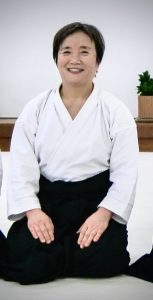
Biographical summary
Born 1948 in Osaka, Japan. Passed away 2024, Toronto, Ontario
Began training at Osaka Aikikai in the late 1960s, at that time under the personal direction of Bansen Tanaka Shihan, a leading student of O-sensei Morihei Ueshiba.
At Osaka Aikikai, she began a lifelong connection with Yukio Kawahara Shihan, who was then an instructor at the dojo.
She first visited Canada and taught briefly at Vancouver Aikikai in 1977.
Relocated permanently to Canada a few years later, training at, and eventually becoming an instructor at, Toronto Aikikai.
In 1990, she founded Aikido Tendokai, fulfilling her dream of expressing her personal Aikido ideals through her own dojo. She co-founded Aikido Hokuryukai (at first known as Samurai Club Aikikai) with her husband, Jim Barnes, shortly after.
- Personally taught children’s classes, inspiring a new generation in Aikido.
Achievements/Contributions
Seventh dan / Shihan; was the highest ranked female Aikidoka in Canada.
Routinely attended and taught Aikido at numerous seminars across Canada every year.
Was a founding member of the CAF Examination/Technical Committee and served as its chairperson in its formative years.
Was a close student, supporter and confidante of Yukio Kawahara Shihan, the CAF’s first Technical Director, for most of his career in Canada.
After Kawahara Shihan passed away in 2011, was instrumental in establishing the Kawahara Shihan Trust Fund, which benefits the CAF.
After Kawahara Shihan passed, she dedicated her efforts to learning from and facilitating the visits of Hayato Osawa Shihan, the CAF’S current Technical Director.
Served as liaison between the CAF, Osawa Shihan and Hombu Dojo.
Enjoyed warm relationships with members of the North American Shihankai, including Yamada Shihan, Kanai Shihan and Tamura Shihan.
Nurtured and mentored students and instructors across Canada, taking particular pleasure in working with and helping to advance female Aikidoka.
Personal philosophy
She believed that Aikido was unequivocally a martial art. She strongly disliked sloppy, weak or “wishy-washy” (as she called it) practice.
She constantly reminded students to practice safely, both for themselves and by protecting their partners.
She believed that Aikido was a spiritual pathway, a link to the divine through practice, complementing an individual’s religious beliefs.
She believed that training should consist of intense practice according to the individual’s ability, that most talking on the mats was completely out of place, and that students who became tired should step out and rest rather than hinder their partner’s training.
She loved the community of Aikidoka. She believed that Aikido students should tirelessly help and encourage each other, a principle she personally embodied through her generosity, wisdom, and attentive guidance.
She felt that Aikido dojos should be places of health, friendship, personal growth and joy.
Summary
Yumi Nakamura Shihan’s life blended deep technical mastery with a passionate commitment to safety, spirituality, and community. From her early days in Osaka to her pioneering role in Canadian Aikido, she left an indelible mark as a teacher, mentor, and advocate internationally. Her legacy lives on through the dojos she founded, the CAF which she tirelessly supported, and the many students she inspired.